By Alexa Burton
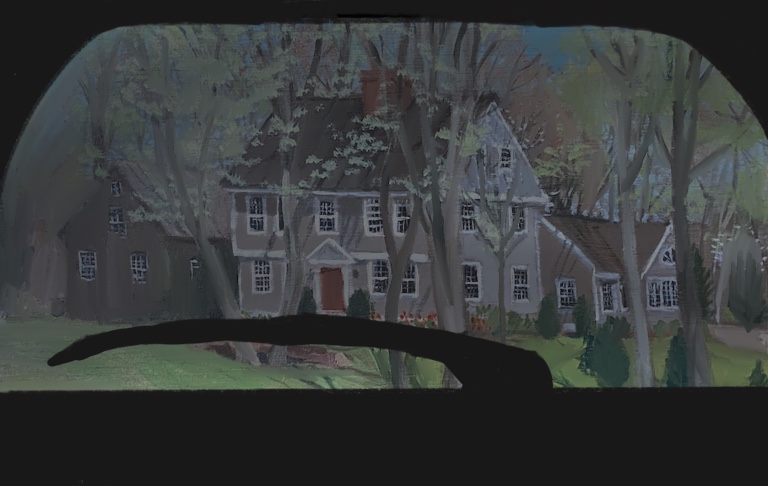
Illustration by Neve Burton, inspired by Diane Aeschliman
He followed the trail of discarded tools to find a hammer in his pigtailed daughter’s hands. She crouched before the entrance to her doorway and beside a pink suitcase—the one purchased for annual visits to his family in their southern home—with a floorboard protruding out the upper end. He rushed to collect the hammer, then gaped at the hole in his hallway floor. “It’s the squeaky one, anyway, so I thought they wouldn’t care if we take it with us,” she said, as if she were in the habit of tampering with the construction of the house, or were familiar with the likes and dislikes of young new homeowners.
When he told her they’d be moving, she hadn’t stirred from her position starfished on the ivory rug. “That’s fine, as long as we take the ceiling with us,” is all she’d said. It was a request so ridiculous that he tried to imagine she didn’t truly believe it was possible. Shuffling in the doorway, he hesitated, then immediately recognized the half-step as the one so many of his friends had taken while passing his daughter’s bedroom just a month before. It’s not normal behavior, lying in silence like that, they’d tried to tell him. But, really, he didn’t know what they’d expected.
Beside the floorboard, which was dirty and caught on the pale and silky insides of the little suitcase, were the hinge from one of the doors, the clasp that kept the window shut with its two rusty screws, and the seat of the tree swing from outside his daughter’s window, its ropes slashed and fraying. He opened his mouth to yell—to be angry at her for being anything but fine in all the same ways he was—until he remembered the Hendersons, their two little children, and the sight of the little boy standing on the swing’s little wooden seat, pumping it back and forth with a childish joy he hadn’t seen in his daughter for weeks. He swallowed down the jealous memory, spoke to his daughter softly, then lifted her up and tucked her into bed. Sliding his back down the door jamb, he sat between his child and the gaping hole as if by placing himself between her and the emptiness, he’d make her life whole again.
When he awoke, she wasn’t in her bed. The house held its breath as he walked from room to room, his pace quickening with each space found empty. Crashing through the back door, he stopped cold on the brick patio. She looked peacefully at war with herself, digging up the garden in an extended trench. The little red wheelbarrow she’d received for her seventh birthday was piled high with dirt and the carefully uprooted pachysandra that used to surround a shrubbish thumb of a tree that sat in the garden’s center. She rinsed her hands in the birdbath, then took up the handles and began wheeling another portion of the garden away. His eyes followed her to the bed of his truck, where foxgloves, yarrow, and creeping thyme burst over the car’s sharp and silver edges. A beautiful sort of destruction.
Mesmerized, he watched her make two more trips between the garden and truck and only broke from his trance when she noticed him. “Daddy, you’re just in time to help me. I don’t think I can move this one on my own,” she said, gesturing to the bird bath. He lumbered down the stairs, stiff as if he’d been immovable for ages, and lifted her onto the edge of the basin. He combed out her wild hair with his fingers and wiped some dirt from her chin as she smiled up at him from beneath dark eyelashes. “I would be done packing the garden soon, but I don’t think you have enough room in the truck. We might have to make a couple of different trips,” she said with the perfect earnesty of childhood.
He’d known how much the first part would hurt: that he’d be trapped in silence the day she decided she’d had enough of treatment. That he’d have to place locks on the bedroom door too high for child hands and slide them into place on the days his wife thought she’d scare her daughter more by letting her in than by shutting her out. That he’d have to carry his daughter to bed one night knowing he was removing her from her mother’s arms for the last time. That on the day of his wife’s death, he’d feel, really, as though he was the one irreparably torn, soul from body.
But this—the simplicity of his daughter’s world, the perfect logic and simple beauty, the persistence of childhood—and the impossibility of shattering her clarity wore away at him in ways he’d never have predicted. He lifted her gently into the wheelbarrow, then bumped her across the grass and towards the back door. He squeaked the spigot until the water ran with a freezing purity from its mouth, and his tough hands enveloped hers as he rinsed soil away from her palms, which emerged soft and pink from the chill. “Inside,” he said quietly, squatting to allow her to climb onto his back. They ducked in unison, passing through the short entryway, and the door folded shut behind them.
Over the course of the week, he boxed and hauled and emptied the caverns of the house, lifting pieces of their lives into truck beds, fixing the swing, replanting the garden. On the final night, all that was left in his child’s room were the mattress and the carpet he’d so often found his wife and daughter lying upon, reading or whispering together in voices just excited enough to carry through the open doorway. He supposed he should have seen it coming. This month, she’d been found standing with her ear pressed against the wall as if she could hear a voice held within it. She’d been using his shower for weeks, insistent that the water drawn by her mother remain in the tub. She’d been living her free moments on this rug, staring at the ceiling painted with stars in her mother’s brushstrokes. This time, he didn’t lift her to her bed, but approached slowly, as if interrupting something sacred, and found his place beside her. They lay for a long time, eyes drawing constellations from spark to spark.
“Hey, honey?”
“Shhh. Can’t you hear her?”
“No, sweetie. She’s not—”
“Listen. Imagine she’s just outside.” The recollections came slowly at first, then one after another: the ticking of the stove before he was fully awake, the click of a knee joint in the stairwell, Vivaldi drifting from the garden through an open window, the creak of that damn floorboard, and the friction of a ladder—or an easel—shifting open. And he could see her now, smiling down at him as he anchored the ladder in place while she climbed, laughing at the bit of paint that dripped onto her freckled cheek. She’d streaked his forehead with a dash of the same color and smiled as he smeared it accidentally on his hands. There she stood, perfectly alive in his mind’s eye, buoyant among the stars. He could hear her voice in health, bright and melodic and gone for so long until now.
He became conscious of his hand pressed above his chest, his vision blurred, his grounding unsteady. Rolling to his side, he found a perfectly familiar expression on an ageless face. For the first time in weeks, tears streamed into his child’s ears. “I know we can’t take the ceiling with us, Daddy.” She continued staring straight up, smiling despite herself as if peering into the face of a friend. “I know we have to leave without her.” He took her hand, squeezed it.
“We’ll paint you another ceiling, okay? We’ll do it together.”
His daughter shook her head. “She only exists in this one.” The child was silent for a moment. “The new house is so quiet. I’m not going to be able to hear her anymore.” She finally ripped her gaze away from the stars, curling against him. He held her until she quieted, stroking her arm as she hiccuped.
Sunlight found them still together, the only life left within a house laid bare. His daughter passed through the home a final time, slipping kisses onto her fingers, then pressing them to each beloved wall. Just before stumbling down the front steps a final time, she dashed back to her hallway and, slowly, deliberately, shifted her weight onto the board her father had nailed back into place. The whine it released was slow and waning, unlike the chipper shriek she’d been expecting. He watched her smile sadly, then nod as if she’d been ready for this change, too. She returned to him, taking up the handle to her little pink suitcase on one side and his hand on the other. Her step was resolute as she charted a path down the driveway, her expression determinedly calm. She slid into the back seat among the last of their belongings, and he stacked her suitcase upon her lap. About to press the ignition, he glanced in the rearview mirror to find his daughter’s eyes squinted in absolute concentration.
“What is it, honey?”
Squeezed tight between cardboard, suitcases, and side tables, she spoke. “It just still feels like we’re missing something.”
The car crawled backwards out of the driveway, and his daughter watched, fogging hand pressed to frozen window, as her house receded into the trees just now beginning to thaw.
 The Grab Bag